










UPDATES

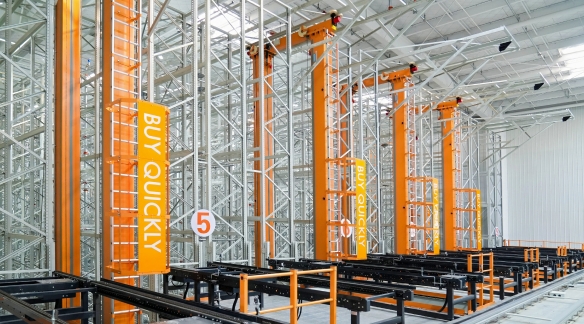
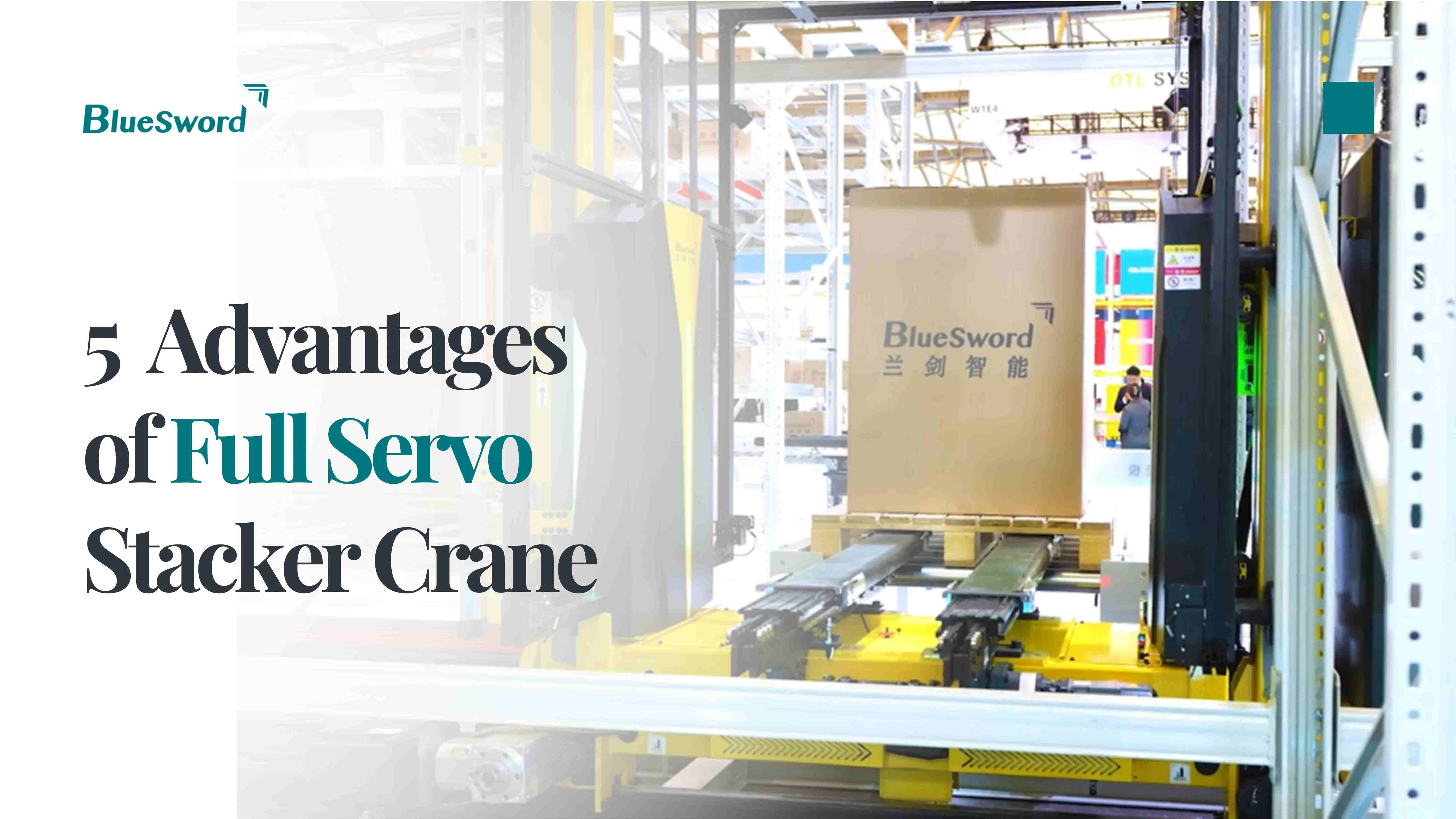
The stacker crane is often called the core engine of an automated warehouse — it directly determines storage efficiency and operating cost. BlueSword's fully servo stacker crane rethinks that engine from the ground up, combining servo technology with structural optimization for medium-to-heavy load, high-precision, high-frequency operation. Here's what that actually delivers.
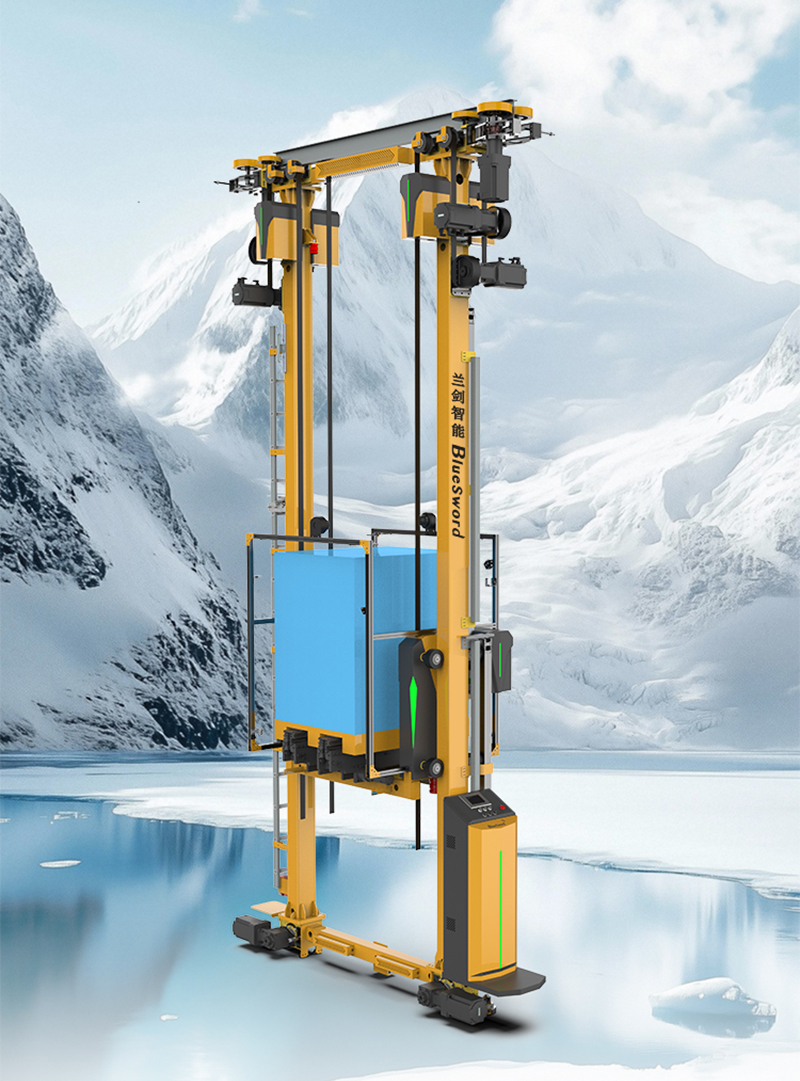
A 40% Lighter Machine, By Design
The weight reduction isn't from swapping one part — it comes from combining a compact servo drive system with structural optimization. Permanent magnet synchronous servo motors weigh only 56% as much as traditional asynchronous motors, and direct-drive technology removes gearboxes and couplings entirely. Layered on top of that, finite element analysis and thousands of prototype tests informed a redesign of the uprights and beams using response surface methods, stripping out structural redundancy while preserving rigidity.
The result is a machine that uses 15–20% less energy, responds to acceleration and deceleration commands 30% faster due to lower startup inertia, and places less load on warehouse flooring — opening up deployment in facilities that couldn't support a heavier automated stacker crane.
Where the Energy Savings Actually Come From
Asynchronous motors lose roughly 20–30% of total motor energy to rotor winding excitation, generated as heat. Permanent magnet servo motors skip that entirely by generating their magnetic field from permanent magnets, which gives them higher efficiency and power factor, lower heat rise, greater starting torque, and a high-efficiency operating range above 90% — compared with under 60% for asynchronous motors running at low speed.
Because stacker cranes run under variable loads with frequent start-stop cycles, servo systems adjust torque output dynamically rather than running an oversized motor against a light load, saving more than 2,200 kWh annually versus an asynchronous equivalent. A power factor close to 1 (versus 0.2–0.85 for asynchronous motors) also reduces the transformer capacity a facility needs, since apparent power scales inversely with power factor — meaning less infrastructure investment upfront. Energy regeneration during lifting and lowering, plus compatibility with solar and other renewable inputs, adds further reduction toward green-factory certification goals.
Millisecond Response, Millimeter Accuracy
Permanent magnet servo motors reach peak torque in under 100 milliseconds — 3 to 5 times faster than the 300–500 ms typical of asynchronous motors — and paired with S-curve motion control, they stay stable at speeds above 240 m/min. A triple closed-loop system covering position, speed, and torque, combined with a 23-bit absolute encoder at 0.01mm resolution, brings positioning accuracy to ±1mm, an 80% improvement over the ±5mm typical of conventional systems.
Servo-driven forks with real-time speed feedback add a fully closed-loop S-curve extension, improving fork efficiency by 40% and tightening positioning deviation from ±15mm down to ±5mm — a meaningful reduction in the risk of dropped cargo.
Built to Hold Up, Not Just Perform
A common assumption is that servo systems trade ruggedness for precision. BlueSword's design counters that by using electromagnetic brakes only for static locking — motion itself is governed by closed-loop servo control — and by certifying operation from -20°C to 50°C with IP54 dust and vibration protection, covering everything from cold storage to lithium battery manufacturing environments.
Top-tier servo components rated for a 10–15 year lifecycle support cross-generation replacement with automatic parameter migration, and the modular architecture cuts troubleshooting time by 60% and annual maintenance costs by 40%.
Built for Where Warehouses Are Headed
Fieldbus control and multi-axis synchronization allow the system to integrate directly with WMS and WCS platforms for lights-out warehouse operation, while high responsiveness and low noise make it compatible with AGV/AMR ecosystems combining aerial and ground transport. In Miniload and ultra-narrow-aisle warehouses under 1.5 meters, the precision and compactness of servo forks become essential for maximizing space utilization rather than just a convenience.
Every claim here has been validated across more than 300,000 industrial operation cycles, and customers are welcome to visit BlueSword's manufacturing facility to compare energy consumption, positioning accuracy, and stability directly against traditional stacker cranes. Choosing BlueSword's fully servo stacker crane is as much about the next 5–10 years of warehouse capability as it is about immediate efficiency gains.
Read More
-

 September 29 / 2026Beyond the Quote: What an Automated Warehouse Costs Over Its Working Life
The real cost of warehouse automation goes far beyond the initial quote. Discover the hidden costs of installation, downtime, maintenance, energy, upgrades, and expansion—and how smarter system design can keep them under control.
READ MORE
-
 June 29 / 2026Inside the Electronics Factory: What Changed in Material Handling This YearREAD MORE
-
 April 28 / 2026Fixed or Flexible: What Manufacturing Deployments Are Telling Us
Fixed infrastructure once defined manufacturing efficiency. But as production cycles shorten and flexibility becomes critical, mobile automation is changing how factories think about material flow.
READ MORE
-
 March 27 / 2026The Part of Your Warehouse Nobody Wants to Talk About
The warehouse's biggest bottleneck may not be where you think. BlueSword looks at why the dock is becoming the next frontier of automation.
READ MORE
-
 January 28 / 20262026 Manufacturing Upgrade and Industry Trends
As manufacturers plan toward 2026, automation, smart manufacturing, and integrated material flow are becoming central to capacity and resilience. This article explores industry trends, labor constraints, and how integrated warehouse and production automation help reduce internal logistics losses and support phased manufacturing upgrades.
READ MORE
-
 September 24 / 2025Why Automated Warehousing Matters
Global supply chains face constant disruption. Automation is redefining warehouses as resilient hubs that keep goods moving no matter the challenge.
READ MORE
-
 August 27 / 2025How Automation Changes the Nature of Frontline Work: Confidence, Retention, and Workforce Value
Automation is no longer just about efficiency—it’s transforming warehouses and factories into safer, smarter, and more rewarding places to work.
READ MORE
-
 August 19 / 2025Automation in Logistics: Solving Workforce Challenges with Smart Systems
Discover smart logistics solutions with AMRs, shuttle systems, and automated warehouses. Future-proof your supply chain with intelligent intralogistics systems.
READ MORE
-
 July 25 / 2025Robotics Driving Real Safety Transformation in Factories and Warehouses
Safety in factories and warehouses is often discussed in terms of compliance and injury rates. But true safety goes beyond meeting standards. It requires addressing the root causes of risks and understanding how automation reshapes the daily reality for frontline workers—physically and mentally.
READ MORE
-
 May 25 / 2025Are Warehouse Robots Here to Replace Workers—Or to Back Them Where It Counts?
Automation is advancing fast—but where does that leave the people on the ground? This article explores why the future of warehousing isn't a story of replacement, but one of smart collaboration. With real-world cases from BlueSword and global data, we dive into what human-machine partnerships really look like on the warehouse floor.
READ MORE
-
 March 30 / 2025What’s Slowing Down Manufacturing—and What Leading Factories Are Doing About It
While automation continues to gain attention across the production line, internal logistics often remains untouched in traditional manufacturing plants.
READ MORE
-
 January 2 / 2025Building a Green Logistics Ecosystem with Servo Technology
The conveyor system is essential in modern production and logistics, facilitating the efficient storage, sorting, handling, and distribution of materials. By automating transport processes, it enhances efficiency, accuracy, and safety while effectively reducing labor costs.
READ MORE
-
 September 29 / 2024Logistics Transformation: Navigating Challenges in the FMCG Industry
Fast-moving consumer goods (FMCG) are an essential part of our everyday lives. With their large market size and ongoing growth, the FMCG industry plays an important role in the global economy.
READ MORE


