









UPDATES

The Infrastructure Decision Has Always Been a Trade-Off
Every automation decision encodes an assumption about the future. Fixed conveyor systems encode one assumption above all others: that the production logic they serve will remain stable long enough to justify locking it into concrete and steel. In high-volume, stable production environments, that assumption holds. The systems deliver, and the investment is sound.
What is shifting is the proportion of manufacturing environments where that assumption still applies. Product lifecycles are compressing. Batch sizes are shrinking. Mixed-model production has become the baseline across automotive, electronics, consumer goods, and industrial manufacturing. When underlying production logic shifts every two to three years, infrastructure designed for a 10-to-15-year horizon accumulates cost and constraint well before it is fully amortized. Deployment data from the past several years reflects this shift in investment patterns directly.
The Full Cost Picture Beyond Capital
Plant directors and operations leaders often evaluate material flow infrastructure on upfront capital. That framing leaves significant costs off the table.
When a product line changes or a facility layout needs to adapt, the cost extends well beyond the rebuild. It includes production stoppages, reconfiguration downtime, retraining, and months of suboptimal throughput during transition. In environments where production logic changes frequently, each reconfiguration cycle adds to the total cost of ownership in ways that rarely appear in the original business case.
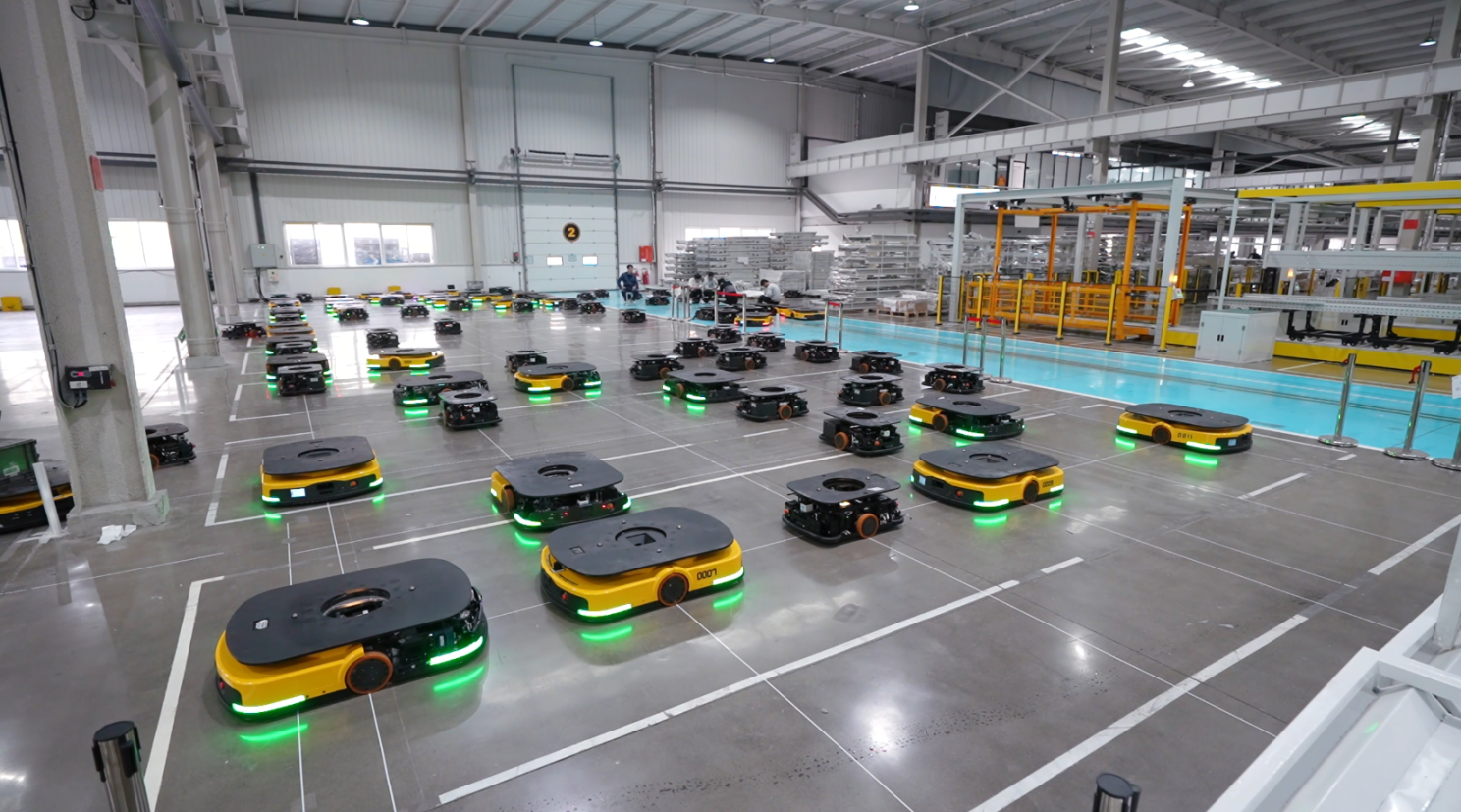
BlueSword's mobile robots testing site
There is also the matter of failure concentration. Fixed conveyor networks consolidate risk at physical nodes. A fault at a critical transfer point affects the entire downstream flow. Companies that select conveyor systems primarily on upfront cost frequently encounter unplanned downtime at significantly higher rates, with total cost of ownership diverging sharply from initial projections. In a just-in-time production environment, any unplanned stoppage carries supply chain consequences, not just maintenance costs.
Honest accounting of material flow infrastructure covers capital, reconfiguration cycles, failure risk, and the operational flexibility required at each stage of production. When that full picture is on the table, the comparison between fixed and mobile solutions looks materially different depending on what the production environment actually demands.
What AMR Deployments Are Demonstrating at Scale
Autonomous Mobile Robots introduce a different infrastructure logic. The path is software-defined rather than physically fixed. Reconfiguring a material flow route is a change in the fleet management system, executed without stopping production and without touching hardware. When a single robot goes offline, its tasks are automatically redistributed across the fleet. When volume increases, additional units are deployed rather than new infrastructure built.
The cost and ROI data from large-scale deployments now makes this comparison concrete. A direct cost comparison from a large-scale AMR deployment at a Fortune 500 manufacturer found that a single AMR unit operating 24/7 cost $40,000 to $50,000 per vehicle annually, compared to $200,000 to $280,000 for the equivalent human-operated forklift including labor and lease. Against fixed conveyor infrastructure, a single AMR unit was calculated to handle the equivalent of 250 linear feet of conveyor at approximately half the cost, with substantially greater operational flexibility.
Across real-world deployments, AMRs have demonstrated operating costs at less than half that of equivalent conveyor systems, with return on investment timelines under two years and internal rates of return exceeding 50%.
These figures come from production environments at scale. The business case for mobile automation in manufacturing is no longer theoretical.
Brownfield Facilities Are Where the Transition Is Happening
New greenfield facilities can architect material flow from first principles. The more consequential question for most organizations is what happens in existing plants: facilities built before mobile automation existed, with legacy infrastructure embedded in every square foot of production space.
Brownfield manufacturing facilities often have aging infrastructure, constrained space, variable conditions, and deeply embedded workflows. The demand for more agile and scalable material movement has driven AMRs to emerge as a compelling alternative to fixed handling systems, particularly when designed to integrate with existing operations without requiring significant structural modification.
AMRs can navigate existing facility layouts without requiring infrastructure teardown or production interruption, though floor surface conditions still need to meet basic flatness and evenness standards for reliable operation. Deployment is incremental: starting with the highest-value material movement tasks, validating performance, then expanding. The production line keeps running throughout.
Ford's approach to brownfield automation across its North American manufacturing estate illustrates the model. Rather than waiting for greenfield programs, the company has invested in AMR-based automation that retrofits existing lines with minimal disruption, prioritizing non-invasive integrations that avoid lengthy line stoppages. AMRs are introduced starting with predictable, repetitive material movement tasks, validated through simulation before hardware rollout, with the strategy deliberately iterative, creating proven deployments that are then replicated across multiple plants. 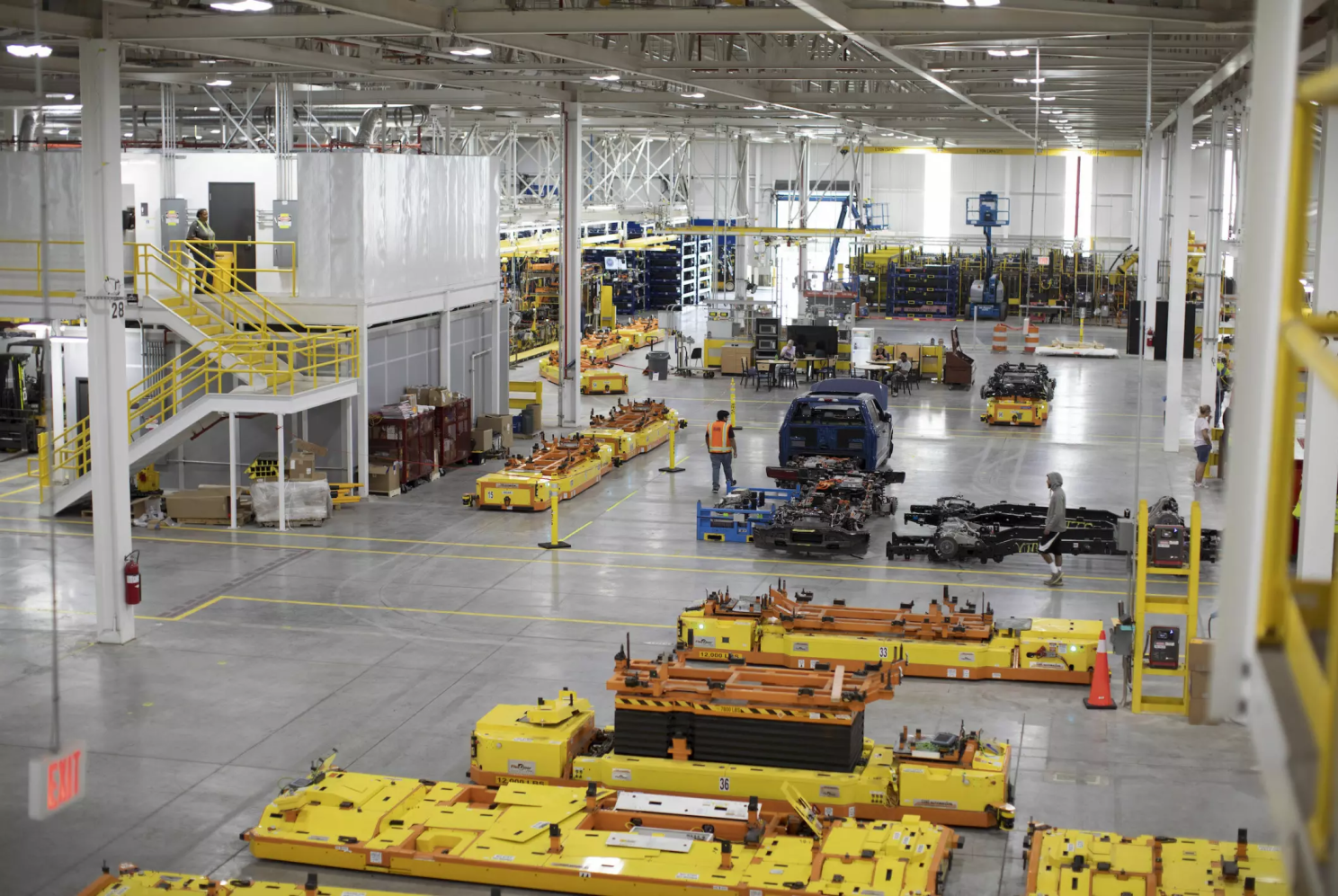
Ford Dearborn truck plant - Ford
This is how AMR adoption scales in manufacturing: a progressive overlay that takes over material movement scope incrementally, workflow by workflow, plant by plant.
The Technology Has Crossed the Threshold
Early reservations about AMRs in manufacturing environments were grounded in real limitations: navigation reliability in dynamic conditions, fleet coordination complexity, and integration friction with existing MES and WMS systems. Current capability has moved substantially beyond those constraints.
LiDAR-vision fusion navigation now delivers centimeter-level positioning accuracy in dense, high-traffic manufacturing environments. AI-driven fleet management systems coordinate dozens of concurrent robots within the same facility footprint, optimizing routing in real time and resolving conflicts without human intervention. Standardized integration protocols, including VDA 5050, enable AMR fleets to operate within existing digital infrastructure rather than alongside it as a separate system.
At DENSO, one of the world's largest automotive component suppliers, AMR deployment across finished kit lines in an ignition plant achieved full coverage within six months of project launch, with return on investment realized in under a year, ahead of the company's standard two-year ROI threshold for capital projects.
Heavy-payload applications are expanding in parallel. AMR platforms rated above 1,000 kg payload are growing at a compound annual growth rate exceeding 18%, as automotive and heavy machinery manufacturers deploy mobile platforms for engine, frame, and large-component transport, applications previously served exclusively by fixed conveyor infrastructure.
The Question Plant Directors Should Be Asking
Fixed conveyor systems retain a rational place across manufacturing. In high-volume, single-SKU production lines where operating conditions are stable and throughput predictability is the primary objective, they remain the right choice. The relevant question is not which solution is categorically better. It is what the specific production environment actually requires, and whether the current material flow infrastructure is matched to how that environment will operate over the next five years.
The global AMR market is projected to grow from USD 2.75 billion in 2026 to USD 7.07 billion by 2032, at a compound annual growth rate of 14.4%. That growth reflects capital allocation decisions made by plant directors and operations executives who have run the full analysis on reconfiguration cycles, downtime exposure, and labor economics across their specific environments.
What deployments are telling us is straightforward: in environments where production logic is stable and volume is consistent, fixed infrastructure continues to perform. In environments where product mix is expanding, batch sizes are shrinking, and reconfiguration cycles are shortening, mobile automation is taking a larger share of new investment.
At BlueSword, what we observe across manufacturing deployments is consistent: investment in mobile automation is expanding across automotive, tobacco, electronics, cold chain, and industrial manufacturing, and the projects we deliver reflect that shift. Our AMR, AGV, autonomous forklift, and conveyor platforms are all built from actual field experience in these environments, covering system design, phased rollout, post-installation support, and ROI modelling from day one.
If you are evaluating your material flow infrastructure against your production roadmap for the next several years, get in touch. We start with the numbers.
Read More
-

 September 29 / 2026Beyond the Quote: What an Automated Warehouse Costs Over Its Working Life
The real cost of warehouse automation goes far beyond the initial quote. Discover the hidden costs of installation, downtime, maintenance, energy, upgrades, and expansion—and how smarter system design can keep them under control.
READ MORE
-
 June 29 / 2026Inside the Electronics Factory: What Changed in Material Handling This YearREAD MORE
-
April 28 / 2026Fixed or Flexible: What Manufacturing Deployments Are Telling Us
Fixed infrastructure once defined manufacturing efficiency. But as production cycles shorten and flexibility becomes critical, mobile automation is changing how factories think about material flow.
READ MORE
-
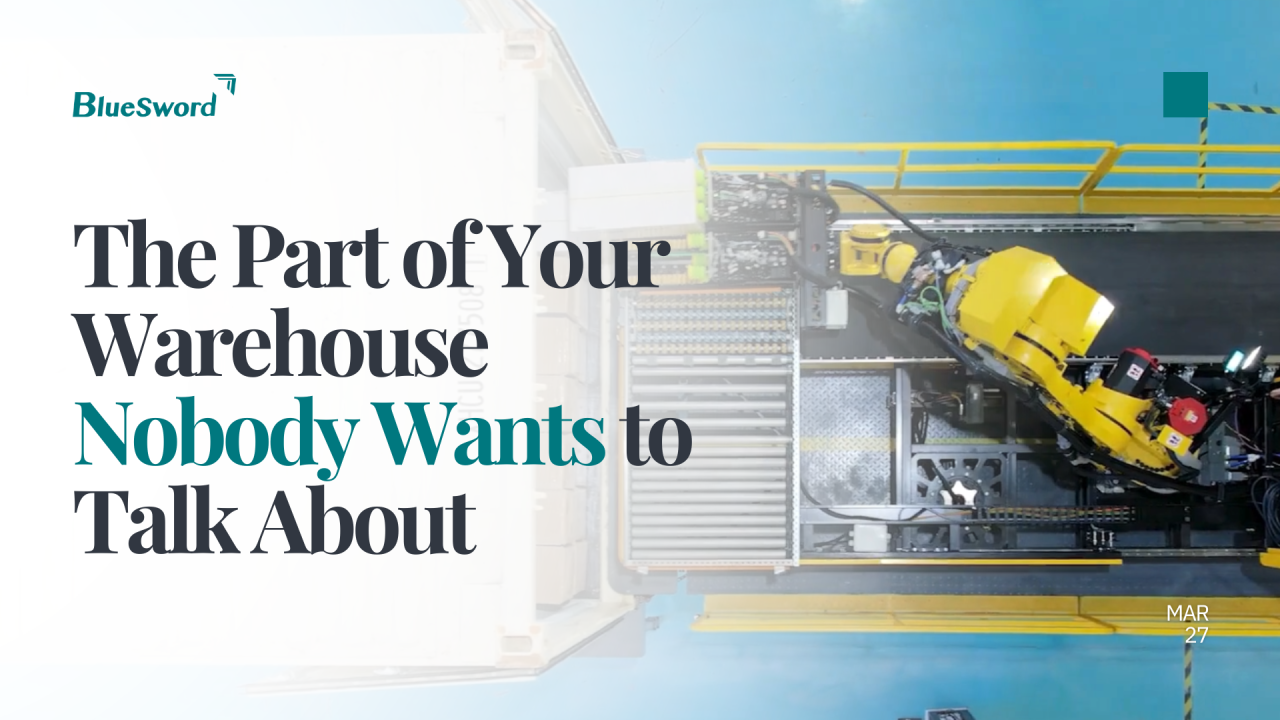 March 27 / 2026The Part of Your Warehouse Nobody Wants to Talk About
The warehouse's biggest bottleneck may not be where you think. BlueSword looks at why the dock is becoming the next frontier of automation.
READ MORE
-
 January 28 / 20262026 Manufacturing Upgrade and Industry Trends
As manufacturers plan toward 2026, automation, smart manufacturing, and integrated material flow are becoming central to capacity and resilience. This article explores industry trends, labor constraints, and how integrated warehouse and production automation help reduce internal logistics losses and support phased manufacturing upgrades.
READ MORE
-
 September 24 / 2025Why Automated Warehousing Matters
Global supply chains face constant disruption. Automation is redefining warehouses as resilient hubs that keep goods moving no matter the challenge.
READ MORE
-
 August 27 / 2025How Automation Changes the Nature of Frontline Work: Confidence, Retention, and Workforce Value
Automation is no longer just about efficiency—it’s transforming warehouses and factories into safer, smarter, and more rewarding places to work.
READ MORE
-
 August 19 / 2025Automation in Logistics: Solving Workforce Challenges with Smart Systems
Discover smart logistics solutions with AMRs, shuttle systems, and automated warehouses. Future-proof your supply chain with intelligent intralogistics systems.
READ MORE
-
 July 25 / 2025Robotics Driving Real Safety Transformation in Factories and Warehouses
Safety in factories and warehouses is often discussed in terms of compliance and injury rates. But true safety goes beyond meeting standards. It requires addressing the root causes of risks and understanding how automation reshapes the daily reality for frontline workers—physically and mentally.
READ MORE
-
 May 25 / 2025Are Warehouse Robots Here to Replace Workers—Or to Back Them Where It Counts?
Automation is advancing fast—but where does that leave the people on the ground? This article explores why the future of warehousing isn't a story of replacement, but one of smart collaboration. With real-world cases from BlueSword and global data, we dive into what human-machine partnerships really look like on the warehouse floor.
READ MORE
-
 March 30 / 2025What’s Slowing Down Manufacturing—and What Leading Factories Are Doing About It
While automation continues to gain attention across the production line, internal logistics often remains untouched in traditional manufacturing plants.
READ MORE
-
 January 2 / 2025Building a Green Logistics Ecosystem with Servo Technology
The conveyor system is essential in modern production and logistics, facilitating the efficient storage, sorting, handling, and distribution of materials. By automating transport processes, it enhances efficiency, accuracy, and safety while effectively reducing labor costs.
READ MORE
-
 September 29 / 2024Logistics Transformation: Navigating Challenges in the FMCG Industry
Fast-moving consumer goods (FMCG) are an essential part of our everyday lives. With their large market size and ongoing growth, the FMCG industry plays an important role in the global economy.
READ MORE


