








UPDATES

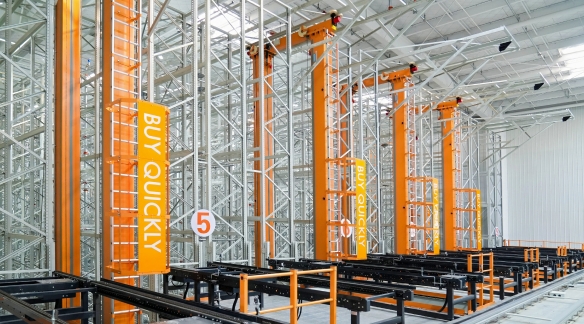
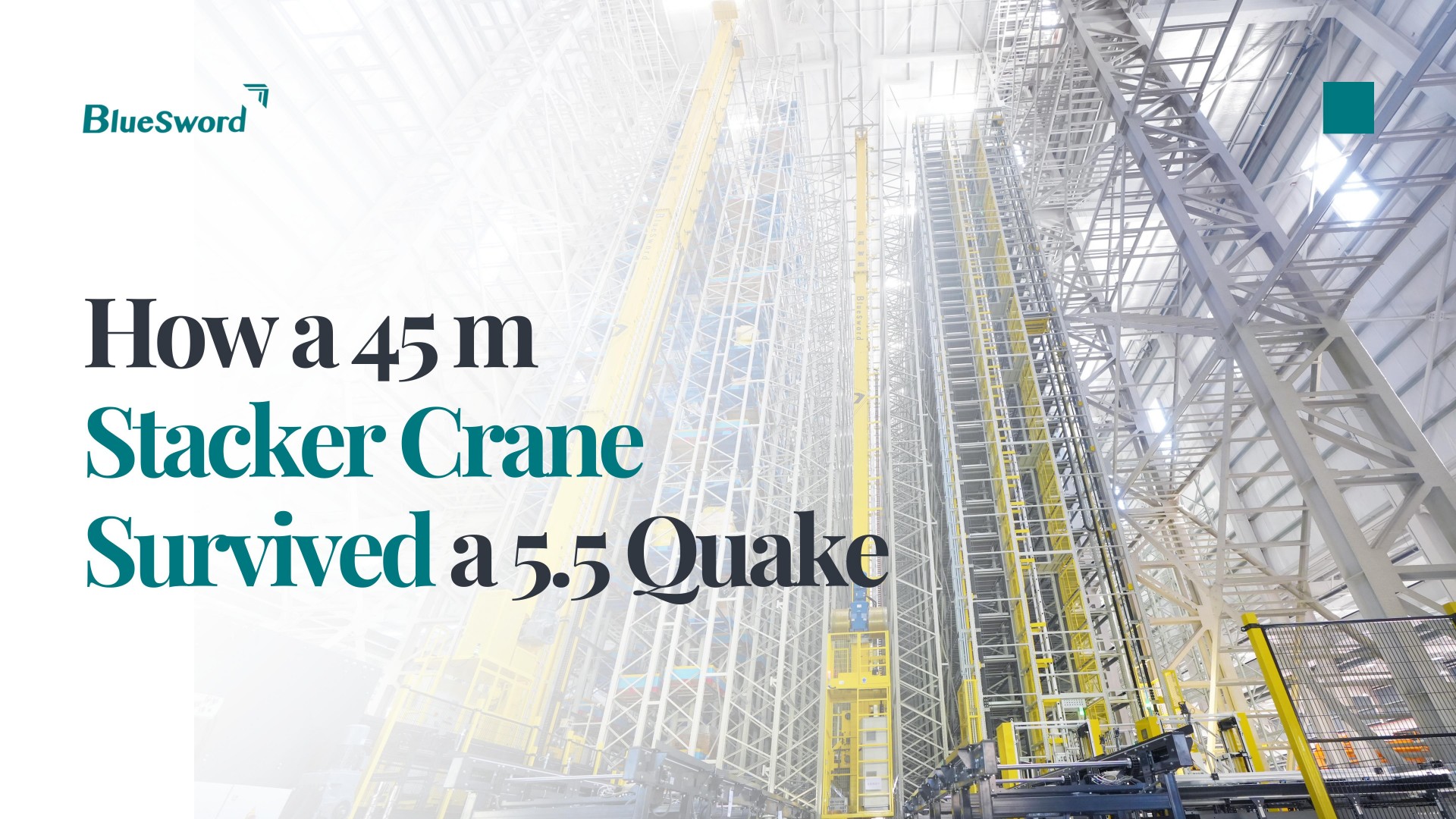
On August 6, 2023, a magnitude 5.5 earthquake struck Pingyuan County in Shandong Province. BlueSword's 45-meter ultra-high automated stacker crane system, was located just 29 kilometers from the epicenter and experienced significant shaking. What happened next is a useful look at how seismic protection actually holds up under real conditions, not just design specs.
The First Check: A Visual Inspection
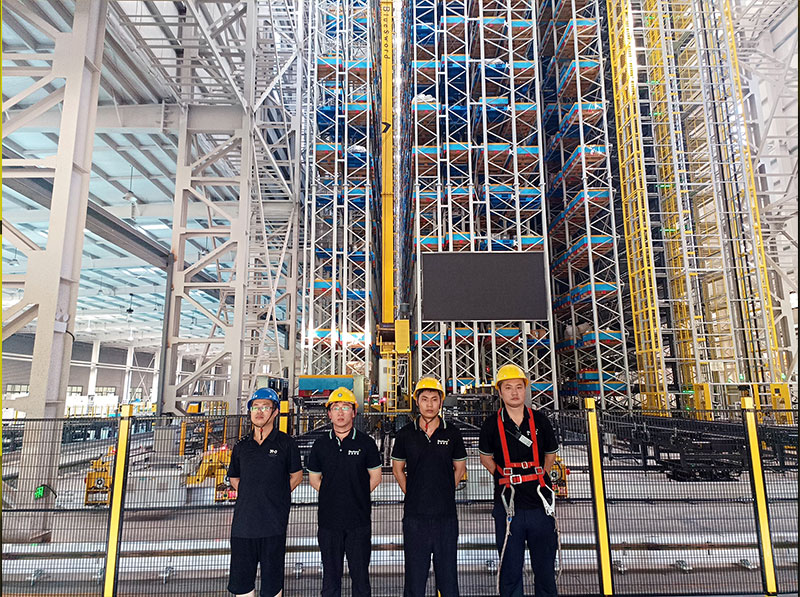
Within hours, BlueSword's technical team began a visual inspection of the automated stacker crane area — checking rack structural appearance, stacker crane integrity, pallet displacement, and any visible deformation. The seismic-resistant racking design showed no visible abnormalities, but the team went further, activating the system's SPS safety early-warning system for a deeper diagnostic across the entire warehouse zone.
What the Gyroscope Sensors Showed
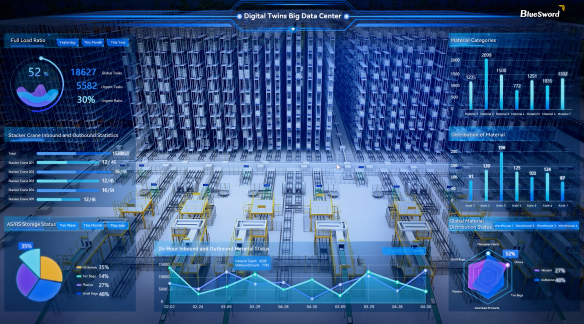
Gyroscope sensors mounted on the stacker crane continuously track tilting or swinging in both static and dynamic conditions — in static mode checking structural deviation in the mast and beams, and during low-speed operation assessing the health of floor and overhead rail systems. Data analysis after the earthquake found no abnormalities in either the crane structure or the rail systems.
Sampling Check Across the Warehouse
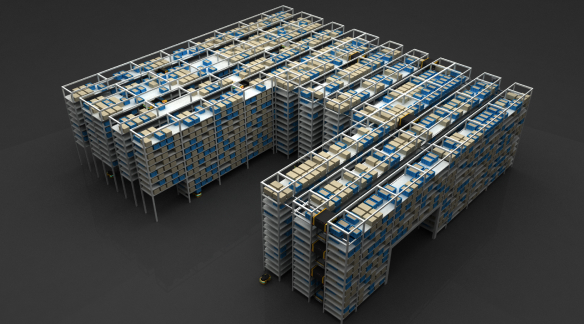
Because strong seismic vibration can misalign rack columns and beams in ways that aren't visible, BlueSword uses an ETI smart electronic pallet system — sensors mounted on an electronic pallet extended into storage locations via the stacker crane forks — to rapidly check rack verticality, horizontality, and structural deviation across zones. Across the system's 3,754 storage locations, the team sampled 187 (a 5% sampling rate) and found no abnormalities in verticality or horizontality.
Confirming Nothing Was Sitting Where It Shouldn't Be
Shaking can also shift pallets enough that goods protrude into a stacker crane's operating space. The system's front-end spatial safety sensor covers full 45-meter vertical intrusion detection, and a low-speed pass across the entire travel path after the earthquake confirmed the operating space remained clear. A small number of pallets — 45 in total — showed minor displacement, with a maximum shift of 2.7cm, none of which affected normal operation.
Built-In Protection Against What Inspection Might Miss
Beyond inspection, BlueSword's cranes carry both contact and non-contact anti-collision protection as a standing safeguard. A contact sensor at the fork's front end detects abnormal contact with a displaced pallet, reports it within 30ms, and halts fork movement within a 50mm safety range — preventing cargo from being pushed off the rack during handling.
A separate non-contact 3D vision system checks for pallet displacement, angle deviation, or damaged fork openings before a pickup action executes, issuing a warning or blocking the operation automatically if something looks unsafe — reducing both the immediate safety risk and the downtime that comes from a failed pickup.
BlueSword's product philosophy centers on what it calls meaningful innovation — the kind of standard a stacker crane manufacturer needs to meet when a system like this one is tested by something as unplanned as an earthquake. The earthquake provided an unplanned real-world test of that principle, and the inspection results offer evidence that a specification sheet alone cannot provide.
Read More
-

 June 29 / 2026Inside the Electronics Factory: What Changed in Material Handling This YearREAD MORE
-
 April 28 / 2026Fixed or Flexible: What Manufacturing Deployments Are Telling Us
Fixed infrastructure once defined manufacturing efficiency. But as production cycles shorten and flexibility becomes critical, mobile automation is changing how factories think about material flow.
READ MORE
-
 March 27 / 2026The Part of Your Warehouse Nobody Wants to Talk About
The warehouse's biggest bottleneck may not be where you think. BlueSword looks at why the dock is becoming the next frontier of automation.
READ MORE
-
 January 28 / 20262026 Manufacturing Upgrade and Industry Trends
As manufacturers plan toward 2026, automation, smart manufacturing, and integrated material flow are becoming central to capacity and resilience. This article explores industry trends, labor constraints, and how integrated warehouse and production automation help reduce internal logistics losses and support phased manufacturing upgrades.
READ MORE
-
 September 24 / 2025Why Automated Warehousing Matters
Global supply chains face constant disruption. Automation is redefining warehouses as resilient hubs that keep goods moving no matter the challenge.
READ MORE
-
 August 27 / 2025How Automation Changes the Nature of Frontline Work: Confidence, Retention, and Workforce Value
Automation is no longer just about efficiency—it’s transforming warehouses and factories into safer, smarter, and more rewarding places to work.
READ MORE
-
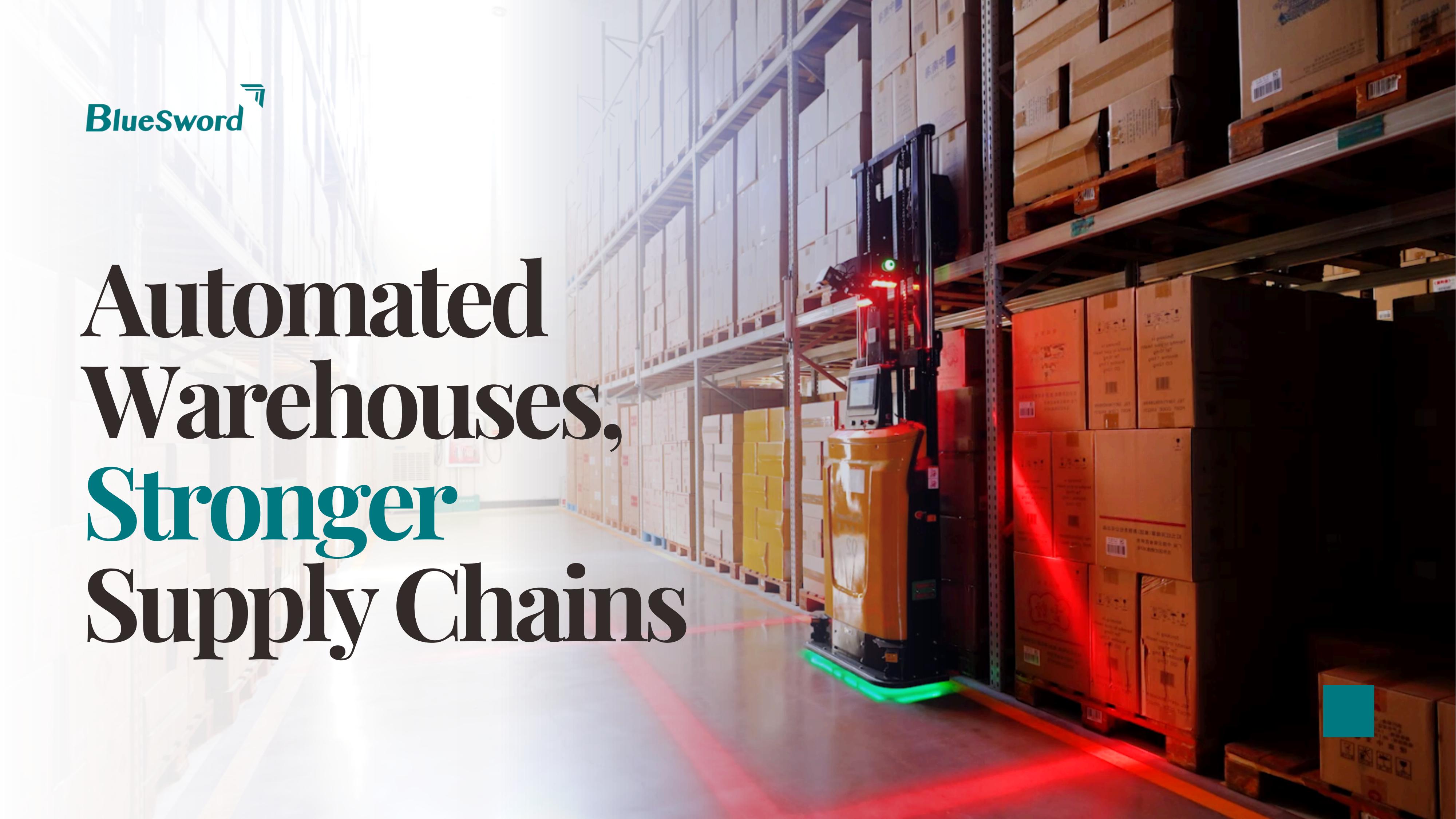 August 19 / 2025Automation in Logistics: Solving Workforce Challenges with Smart Systems
Discover smart logistics solutions with AMRs, shuttle systems, and automated warehouses. Future-proof your supply chain with intelligent intralogistics systems.
READ MORE
-
 July 25 / 2025Robotics Driving Real Safety Transformation in Factories and Warehouses
Safety in factories and warehouses is often discussed in terms of compliance and injury rates. But true safety goes beyond meeting standards. It requires addressing the root causes of risks and understanding how automation reshapes the daily reality for frontline workers—physically and mentally.
READ MORE
-
 May 25 / 2025Are Warehouse Robots Here to Replace Workers—Or to Back Them Where It Counts?
Automation is advancing fast—but where does that leave the people on the ground? This article explores why the future of warehousing isn't a story of replacement, but one of smart collaboration. With real-world cases from BlueSword and global data, we dive into what human-machine partnerships really look like on the warehouse floor.
READ MORE
-
 March 30 / 2025What’s Slowing Down Manufacturing—and What Leading Factories Are Doing About It
While automation continues to gain attention across the production line, internal logistics often remains untouched in traditional manufacturing plants.
READ MORE
-
 January 2 / 2025Building a Green Logistics Ecosystem with Servo Technology
The conveyor system is essential in modern production and logistics, facilitating the efficient storage, sorting, handling, and distribution of materials. By automating transport processes, it enhances efficiency, accuracy, and safety while effectively reducing labor costs.
READ MORE
-
 September 29 / 2024Logistics Transformation: Navigating Challenges in the FMCG Industry
Fast-moving consumer goods (FMCG) are an essential part of our everyday lives. With their large market size and ongoing growth, the FMCG industry plays an important role in the global economy.
READ MORE


