








UPDATES

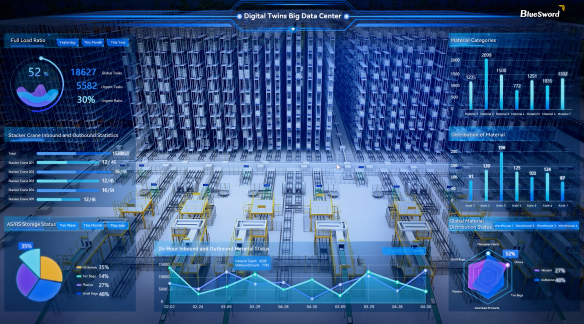
As supply chains become increasingly complex, organizations are turning to simulation technologies to improve planning accuracy and operational efficiency. In particular, logistics & warehouse digital twins and digital twins in logistics have emerged as powerful tools for modeling warehouse behavior, testing operational scenarios, and optimizing system performance before physical implementation.
However, despite their potential, implementing logistics simulations is not without challenges. For many enterprises, especially those scaling automation or redesigning warehouse infrastructure, aligning digital models with real-world operations requires careful consideration of data quality, system integration, and lifecycle management. BlueSword addresses these challenges through its VirtuSync Digital Twins platform, which enables more structured and data-driven simulation processes.
Data Accuracy and Real-Time Synchronization Limitations
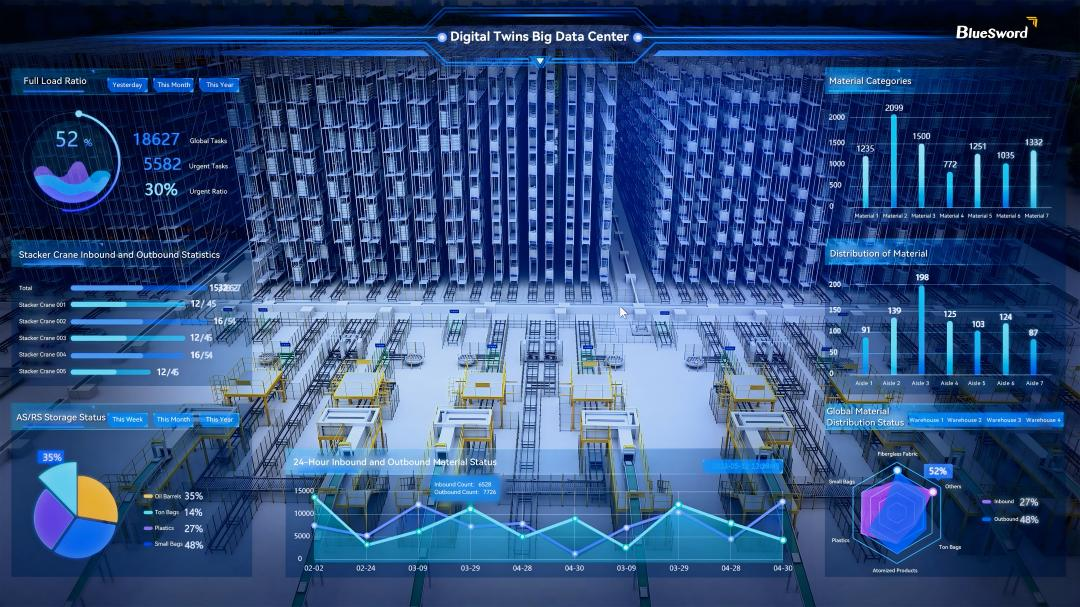
One of the most critical challenges in deploying logistics & warehouse digital twins is ensuring accurate and continuously updated data. Digital simulations rely heavily on real-time inputs from warehouse systems, including inventory levels, equipment status, and workflow movements. If data is incomplete or delayed, the simulation output may deviate significantly from actual operational conditions.
In the context of digital twins in logistics, even small inconsistencies in data synchronization can affect decision-making accuracy. For example, mismatched timing between conveyor systems, automated storage, and order processing modules may lead to incorrect performance predictions.
BlueSword’s VirtuSync Digital Twins platform is designed to address this issue through real-time data exchange mechanisms. By continuously updating simulation models throughout the warehouse lifecycle—from initial design to ongoing maintenance—the system improves alignment between digital environments and physical operations. However, maintaining this level of synchronization across multiple subsystems remains a technical challenge for many logistics operators.
Complexity in System Integration Across Warehouse Infrastructure
Another significant challenge lies in integrating digital twin systems with existing warehouse infrastructure. Modern logistics environments often include a combination of automated conveyors, storage equipment, and warehouse management software. Ensuring seamless connectivity between these components is essential for accurate simulation.
For logistics & warehouse digital twins, integration complexity increases as the number of connected devices and data sources grows. Each system may use different communication protocols, update cycles, and data formats, making standardization difficult.
Within digital twins in logistics, integration is not limited to hardware systems but also extends to operational logic and workflow modeling. Without a unified framework, simulation accuracy can be compromised by fragmented system behavior.
BlueSword’s VirtuSync platform is built to support end-to-end integration across warehouse systems. By connecting operational data with high-fidelity simulation models, it enables more coherent system representation. However, achieving full interoperability across legacy systems and new automation technologies continues to be a key implementation challenge in real-world deployments.
Simulation Fidelity Versus Operational Practicality
Balancing simulation precision with operational usability is another important challenge in logistics & warehouse digital twins. High-fidelity models can represent warehouse behavior in great detail, but they often require significant computational resources and complex configuration processes.
In digital twins in logistics, overly complex models may slow down decision-making or limit the ability to test multiple scenarios efficiently. On the other hand, simplified models may fail to capture critical operational variables, reducing simulation reliability.
BlueSword addresses this balance through its VirtuSync Digital Twins platform, which supports scalable simulation fidelity depending on operational requirements. This allows warehouse operators to adjust model complexity based on planning, optimization, or maintenance needs. Even so, determining the appropriate level of simulation detail remains a strategic challenge for many logistics organizations.
Advancing Practical Implementation of Digital Twin Systems
Implementing logistics simulations requires more than advanced modeling technology; it demands accurate data, seamless integration, and carefully balanced simulation design. These challenges are central to the adoption of logistics & warehouse digital twins and the broader use of digital twins in logistics across modern supply chains.